
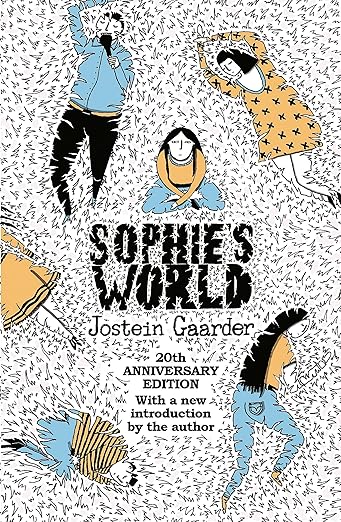
Book Title: Sophie’s World • Author: Jostein Gaarder • English Translation: Paulette Miller • Publisher: Weidenfeld & Nicolson
I finally finished this book! I originally bought this book on Kobo the summer before uni, as I knew I’d be doing some philosophy at uni, yet I had no idea what philosophy is. After doing some research, I found this book to be an introductory book to philosophy, so I thought I’d finish this before starting my uni. But I seemed to overestimate my English, and I gave up after reading just 18% of the book. I was so lost and confused to read even a page of the book, because I barely knew half of the words used in the book (I should have tried the Chinese version instead!). I forgot this book is actually in my library on my Kobo, until one day I found it out when I tried to finish those unfinished books. But yeah, here we are, I finally finished the book, and probably learnt some history of Western philosophy. (I feel so ashamed every time I tell people that I did some philosophy at uni, as I’m so sorry, but I don’t really know even the very basics of the subject. The first book I actually read in philosophy is the textbook in my first philosophy module at uni, which is in logic…)
For anyone who is interested in reading an introductory philosophy book, this book is a good start without a doubt. It’s written as a novel to introduce the history of Western philosophy, making some boring philosophical theories more appealing to the audience. The plot is quite simple: Sophie Amundsen, a 14-year-old girl in Norway, received letters and some postcards addressed to Hilde Møller Knag. Sophie later started to receive materials for the history of Western philosophy, from which she began her philosophy course with an old man, Alberto Knox. Alongside the mysterious philosophy course Sophie was given, she also found that her life was associated with the girl Hilde. When Sophie learnt about Berkeley in her philosophy course with Alberto, it finally revealed that Sophie and Alberto are just characters in the book by Hilde’s father, Albert Knag, who is a major working for the UN in Lebanon. Albert wrote this book for her daughter, Hilde, as a present for her fifteenth birthday. Thereafter, the book crossover between Sophie and Alberto (the world in the book by Albert), and Hilde (the reality). The book finished when Albert returned to Norway from Lebanon and reunited with her daughter, Hilde, while Sophie and Alberto escaped from the world of the book.
This book is a good introductory philosophy book, and I think most people would enjoy it, especially if it’s your first time reading something in philosophy. But, for me, I think the novel part is amazing, yet I found the nonfiction part not as interesting. Don’t get me wrong. I think this is a good book in general. It’s rare to find philosophical ideas explained in a novel, and it’s definitely bite-sized and accessible to many readers, including young adults and grown-ups. The way the book explains the long and illustrious history of Western philosophy is brilliant. I just want something more than merely describing every philosopher and their theories, without illustrating the skeleton of their arguments. I understand that, as a short introductory book to the long and illustrious history of Western philosophy, it probably doesn’t have the space to illustrate every detail, and it shouldn’t. If I’ve never done any philosophy, I’d probably go crazy if I had to read the entire argument. But I guess because I’ve learnt some philosophy, I don’t really enjoy the descriptive things that much. I also found myself getting bored with the chapter on the Middle Ages, but that’s certainly due to my disinterest in Christianity.
Overall, this is a fantastic introductory philosophy book. I definitely learnt a lot about the history of Western philosophy from the book, which I had no idea about before reading it. I particularly like the chapter about Charles Darwin. I once attended some classes in the philosophy of science (which I later swapped to another module for god’s sake) in my second year. We were divided into several groups of two to discuss a question we randomly assigned in the first seminar. My group got a question about how we think of Darwin’s theory of evolution. As I had no idea who Darwin was, I embarrassingly told my groupmate that I didn’t understand the question (yes, I’m so ignorant). So, at least now I learnt some about Darwin, and I wouldn’t put myself in that embarrassing seminar situation again! Well, I also have to say, I’m not completely ignorant. I’ve heard of Darwin (just not in English, so I didn’t know he was Darwin) and always had a blurry idea about his theory.
Btw, I came across a blog about the translation of Sophie’s World on a Taiwanese blogging platform. The blogger there was comparing the English version of Sophie’s World to two different Chinese translations. What I’m wondering is, is it really that meaningful to compare the English version and the two Chinese versions? Sophie’s World is a Norwegian book, originally written in Norwegian. English isn’t the original language of the book; the English version is also being translated, so how can we use the English translation to compare with the Chinese versions and see how accurate they are? Idk. Some may say English is more linguistically similar to Norwegian, and as not many of us can understand Norwegian, using the English version to compare the Chinese translations is compatible. I just don’t really like the idea of comparing two translated versions in different languages and seeing how accurate they are. For me, once you’re translating from one to another, it already involves how the translator interprets the texts. So, comparing the English and the two Chinese versions is merely trying to see if any of the two Chinese translators has a more similar interpretation to the book with the English translator.
Discover more from Space of Ju
Subscribe to get the latest posts sent to your email.